Behind the Scene
The Idea Behind the Title
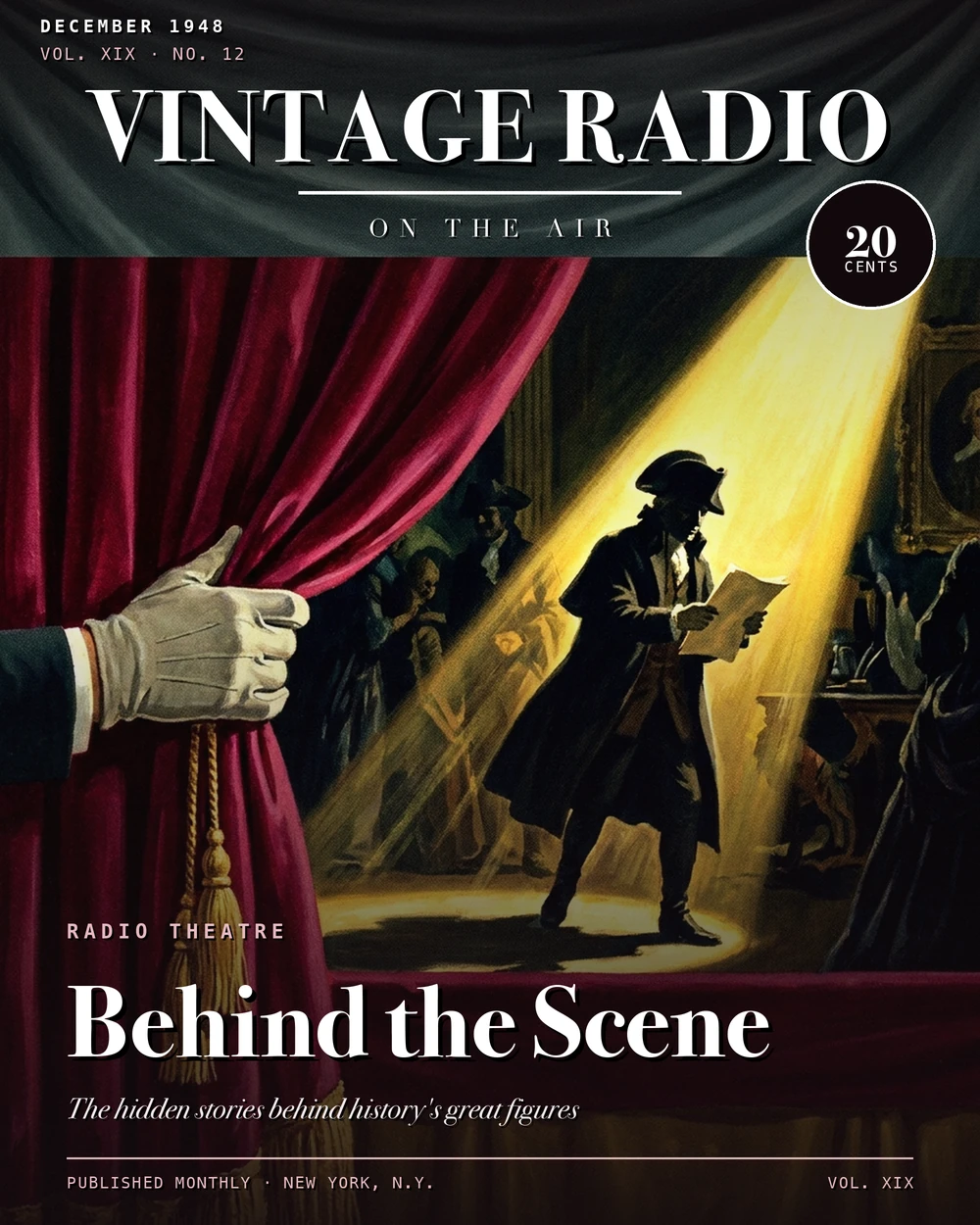
The title Behind the Scene promises an insider's look, and in a sense it delivers — just not the kind you might expect. This 1947 syndicated series didn't pull back the curtain on radio studios or interview directors about their craft. Instead, host Knox Manning took listeners on what he called "a brief journey behind the scenes" of history itself: the little-known episodes, odd turns, and overlooked moments that explain how famous people actually got where they did. The real subject was always a historical figure — Sarah Bernhardt, F.W. Woolworth, Charles de Gaulle, George Pullman — and the draw was the detail hiding just outside the standard account.
That framing made the show something specific: a historical curiosity program built around dramatized re-creations of real events. Each episode ran roughly four minutes, which is short even by old-time radio standards. The format demanded economy. There was no room to wander — Manning had to establish a figure, set up the lesser-known fact or turning point, dramatize it, and close out, all inside the length of a pop song. The surviving catalog holds around 20 to 22 episodes, and with each one clocking in at four minutes, the entire run can be heard in about an hour and fifteen minutes.
Knox Manning and What He Brought to the Show
The series lives or dies on its narrator, and Manning was well suited to the job. Born Charles Knox Manning on January 17, 1904, he had spent years as a radio newscaster at KNX, the CBS Radio outlet in Los Angeles, and had built a reputation as one of Hollywood's most in-demand voice narrators. From 1940 to 1954 he narrated Columbia Pictures serials, and he also worked on The Adventures of Sherlock Holmes radio program. By the time Behind the Scene went to syndication in 1947, Manning's voice was already familiar to a wide audience — authoritative but not stiff, the kind of delivery that made a short story feel complete.
His program has been described as featuring "dramatized re-creations of news events involving famous historical figures," which is an accurate summary of the experience. Manning didn't lecture; he narrated with momentum, moving the listener through an event the way a good newsreel announcer would — present tense, clear stakes, a clean landing at the end. For a four-minute format, that was the only approach that worked.
What the Episodes Actually Cover
The range of subjects across the surviving episodes is broad and deliberately eclectic. Some are straightforwardly historical: Charles de Gaulle and his early thinking about armored warfare, George Pullman and the development of his sleeping car, Alexander Graham Bell in conversation with Mark Twain. Others lean toward the curious or the unexpected — an episode about Ellie Culverson inventing the game of bridge, another about Dr. Joseph Plateau's foundational work that made motion pictures possible. The episode titled "Tony Killed Instead of FDR" suggests the series was willing to reach into dramatic near-miss history as well.
Then there are the cultural figures: Sarah Bernhardt, Mozart and Marie Antoinette, a Gulliver's Travels episode that presumably treats the book's origins or Swift himself. The mix points at a program that wanted variety above all else — one week a military strategist, the next a theater legend, the next an inventor most listeners had never heard of. That unpredictability was likely part of the appeal. You couldn't predict where Manning would take you, but you knew the story would be tight and the detail would be something you hadn't heard before.
The show has been loosely compared to Believe It or Not, the Ripley franchise built on improbable true facts, and that's a reasonable comparison for the spirit of it. Both programs mined the strangeness already present in real history rather than inventing anything. Behind the Scene just dressed those strange facts in a slightly more narrative coat.
A Syndicated Show in the 1947 Landscape
Syndication in 1947 meant the show wasn't tied to a single network or a single broadcast schedule. Individual stations could acquire the episodes and air them on their own timetable, which suited the format — a four-minute program could slot into almost any part of a broadcast day without disrupting the surrounding schedule. It also meant the series could travel without the overhead of a live weekly production. Once an episode was recorded, it existed as a discrete unit ready to be shipped and aired.
This syndicated model also explains the relatively modest surviving count. Unlike network programs with press coverage and sponsor archives, syndicated short-form series from this era often left thinner paper trails. The roughly 20 to 22 surviving episodes may represent the bulk of what was produced, or they may be a surviving portion of a longer run — the record doesn't clearly settle that question. What's clear is that the series had enough coherence and production quality to circulate, and that Manning's narration gave it a consistent identity across subjects as different as FDR assassination plots and the prehistory of motion pictures.
One related note worth making: there was a separate syndicated series called Behind the Scenes in Hollywood, hosted by RKO publicist Bidwell McCormick. The two programs share a similar title and have been cross-referenced in OTR catalogs, but they are distinct shows with different formats and different hosts. McCormick's program covered the film industry; Manning's covered history. The confusion between them is understandable given the overlapping titles, but the content doesn't overlap.
What Holds Up
Four-minute historical dramatizations are an unusual artifact of the radio era, and Behind the Scene is a clean example of the form. The show didn't try to be more than it was. It found a figure, found the angle on that figure that most people didn't know, and dramatized it briskly with Manning's delivery holding the whole thing together. The subjects range from military history to invention to performance to sport, with enough variety across the surviving episodes to keep the run from feeling repetitive.
Manning himself remained active in voice work for decades — he died on August 26, 1980 — and Behind the Scene sits as one of the more distinctive entries in a long career spent in front of microphones. For a program with no premiere date in the record and a total runtime that fits comfortably within a single commute, it covered an impressive span of history.